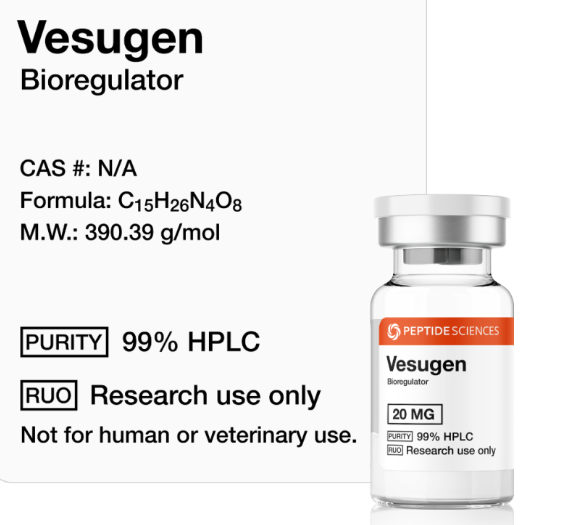
Vesugen (Lys–Glu–Asp; KED) is a synthetic tripeptide investigated as a molecular regulator of vascular-associated gene expression and cellular signaling pathways. Preclinical studies have examined its role in endothelial cell regulation, neuronal cell survival signaling, and transcriptional control mechanisms relevant to vascularized tissues. Due to its short amino acid sequence and linear structure, Vesugen is utilized in controlled laboratory experiments focused on peptide-mediated modulation of cellular and molecular processes.
This compound is supplied exclusively as a laboratory research reagent for use in non-clinical experimental systems, including in-vitro models and in-vivo animal studies.
Biochemical Characteristics
Amino Acid Sequence: Lys–Glu–Asp (KED)
Molecular Formula: C15H26N4O8
Molecular Weight: 390.39 g/mol
PubChem CID: 87571363
Synonyms: lysylglutamyl aspartic acid, SCHEMBL3767701, CHEBI:159909
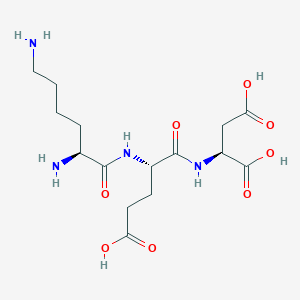 Source: PubChem
The tripeptide does not adopt higher-order secondary or tertiary structures under standard laboratory conditions. This structural simplicity facilitates reproducible biochemical interaction studies involving nucleic acids, transcription factors, and intracellular signaling complexes.
Research Applications
Vesugen is employed in experimental research to investigate peptide-driven regulation of endothelial function, neuronal gene expression, and metabolic signaling pathways. Its biochemical properties make it suitable for mechanistic studies examining oxidative stress responses, transcriptional regulation, and peptide-mediated modulation of intracellular enzymes in preclinical models.
- Endothelial cell proliferation and gene expression studies
- Neuronal differentiation and survival signaling research
- Sirtuin-associated metabolic pathway investigations
- Oxidative stress and hypoxia-response models
- Epigenetic regulation and transcriptional control assays
Pathway / Mechanistic Context
Preclinical research indicates that Vesugen influences gene expression through peptide–DNA and peptide–protein interactions that alter transcriptional activity in vascular and neural cell populations. Experimental models have demonstrated modulation of pathways involving sirtuin 1 (SIRT1), endothelin signaling, and oxidative stress response enzymes.
At the molecular level, KED peptides have been associated with regulation of transcription factors involved in apoptosis control, cellular proliferation, and metabolic homeostasis. These effects are studied within controlled laboratory environments using cellular systems and animal models.
Preclinical Research Summary
In-vitro and in-vivo animal studies have examined Vesugen in the context of endothelial regulation, neuronal marker expression, oxidative stress modulation, and metabolic signaling. Rodent-based models have been utilized to explore its effects on vascular integrity, lipid-associated pathways, and transcriptional regulation of cellular survival mechanisms.
Additional investigations have evaluated Vesugen within experimental neurobiology and metabolic research frameworks, focusing on hypoxia-response pathways, mitochondrial regulation, and epigenetic control of gene expression. All findings remain confined to exploratory preclinical research.
Form & Analytical Testing
Vesugen is supplied as a laboratory-grade peptide for analytical and experimental applications. Identity and purity may be confirmed using standard analytical methodologies such as high-performance liquid chromatography (HPLC), mass spectrometry (MS), and amino acid composition analysis.