
How was P21 Developed?
P21 was developed using epitope-mapping strategies designed to identify minimal peptide sequences capable of modulating CNTF-associated signaling environments. Antibodies directed against CNTF receptor–associated epitopes were used to define target interaction regions and to screen synthetic peptide candidates for interference with antibody binding under controlled experimental conditions. This process led to identification of DGGL-based peptide motifs suitable for mechanistic studies.
Subsequent chemical modification through addition of an adamantylated glycine residue was employed to enhance experimental stability and persistence in preclinical model systems. These features render P21 suitable for controlled laboratory investigation of neurotrophic signaling pathways.
Pathway / Mechanistic Context
Preclinical investigations in rodent models have associated P21 exposure with altered cellular proliferation and differentiation markers within the dentate gyrus of the hippocampal formation. The dentate gyrus is a well-characterized neurogenic niche frequently used to study transcriptional and signaling events associated with neuronal lineage progression in adult mammals.
Experimental observations include increased incorporation of bromodeoxyuridine (BrdU) and elevated expression of neuronal markers such as NeuN in defined hippocampal subregions. These readouts are interpreted as indicators of altered cell-cycle dynamics and neuronal maturation under experimental conditions.
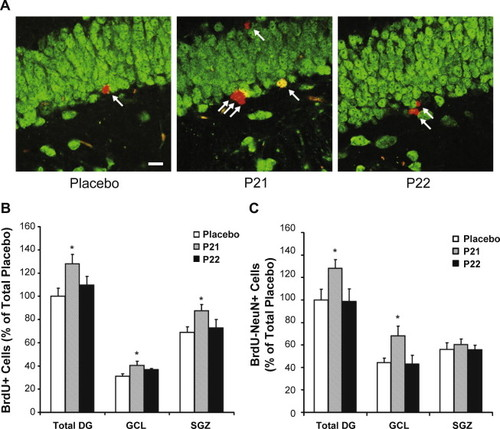 Representative BrdU and NeuN immunolabeling patterns reported in rodent experimental models.
Signaling Network Associations
Mechanistic studies describe modulation of signaling pathways involving leukemia inhibitory factor (LIF), JAK/STAT-associated transcriptional regulation, and neurotrophin-linked signaling cascades. Inhibition of LIF-associated signaling has been discussed as a permissive factor for differentiation-associated gene expression in neural precursor populations.
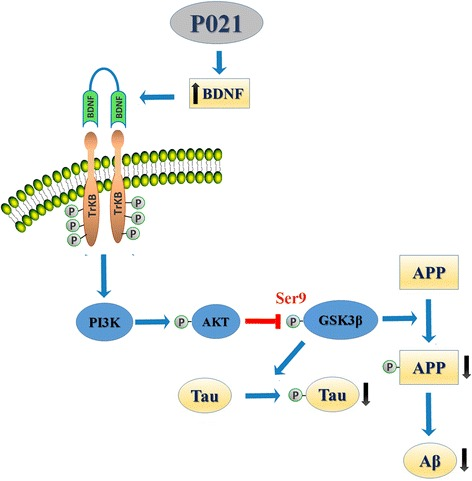
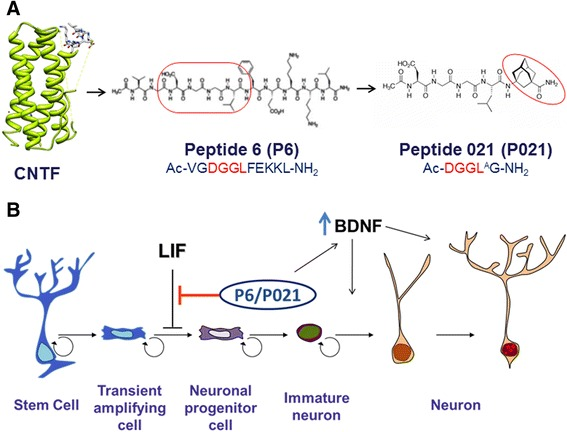 Additional experimental reports describe altered expression or activity of molecular intermediates associated with BDNF, PI3K, and GSK-3β pathways. These nodes are widely studied in neuroscience research as regulators of cytoskeletal organization, synaptic architecture, and transcriptional plasticity.
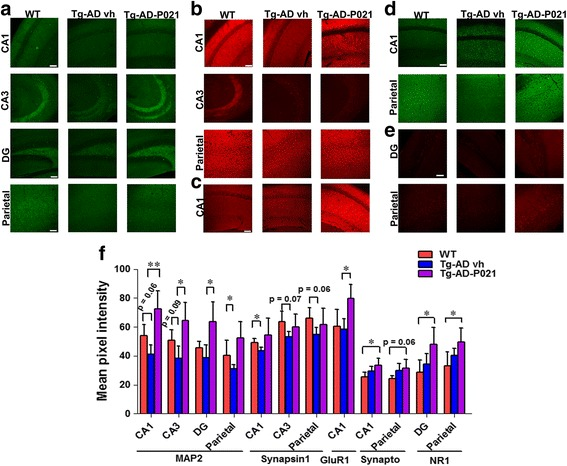
 Changes in expression of synaptic markers including MAP2, synapsin I, GluR1, and NR1 have been reported in animal models exposed to P21. These proteins are commonly employed as molecular readouts in studies of synaptogenesis and neuronal connectivity in both baseline and disease-model contexts.
Preclinical Research Summary
P21 is a synthetic CNTF-derived peptide used exclusively as a laboratory research tool for investigating neurotrophic signaling, neurogenesis-associated transcriptional programs, and pathway-level regulation in preclinical experimental systems. All reported findings derive from in vitro assays or in vivo animal studies and are presented for scientific and educational purposes only.