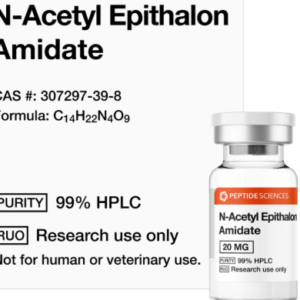
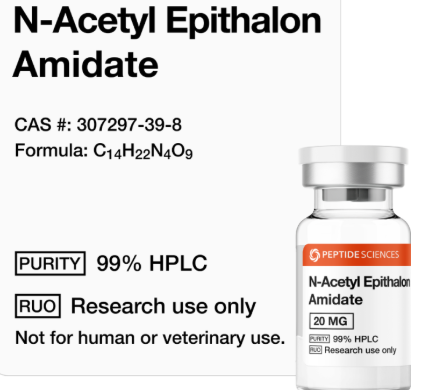
N-Acetyl Epithalon Amidate is an N-terminally acetylated and C-terminally amidated derivative of the synthetic tetrapeptide commonly referenced in the literature as Epithalon (Epitalon; Ala-Glu-Asp-Gly). The parent tetrapeptide was originally characterized in the context of peptide bioregulator research and has been investigated across preclinical models for its capacity to modulate transcriptional programs, redox-associated biochemical readouts, and telomere/telomerase-related parameters under defined experimental conditions.
Current research attention has focused on mechanistic hypotheses that include epigenetic regulation of gene accessibility and downstream effects on protein synthesis during lineage specification in cellular models, as well as systems-level effects measured in animal studies under controlled experimental illumination conditions.
Biochemical Characteristics
Amino Acid Sequence: Ala-Glu-Asp-Gly
Chemical Formula: C14H22N4O9
Molecular Mass: 446.45 g/mol
PubChem CID: 219042
CAS Number: 307297-39-8
Synonyms: Epitalon, Epithalone, Epithalamin, Epithalamine
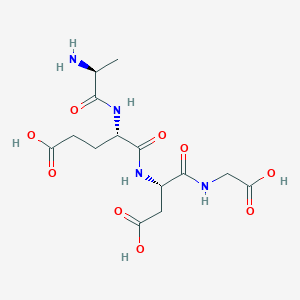 Source: PubChem
In peptide nomenclature, Ac- denotes N-terminal acetylation and -NH2 denotes C-terminal amidation. These end-capping modifications are commonly employed in peptide chemistry to reduce susceptibility to exopeptidase-mediated degradation and to modify physicochemical properties such as charge distribution, which can influence stability and persistence in experimental biological matrices.
Research Applications
N-Acetyl Epithalon Amidate is supplied exclusively as a research reagent for use in non-clinical laboratory investigations focused on short-peptide signaling and genome-associated regulatory mechanisms. Published preclinical and in-vitro literature has utilized the parent peptide (Ala-Glu-Asp-Gly) in experimental contexts including:
- Cellular differentiation models: analysis of transcriptional and translational changes during neurogenesis and lineage specification in controlled cell culture systems.
- Gene expression profiling: evaluation of cytoskeletal and developmental marker expression (e.g., Nestin, GAP43, βIII-tubulin, Doublecortin).
- Redox biochemistry assays: assessment of lipid peroxidation-associated products and oxidative protein modification markers in animal-based experimental models.
- Telomere and telomerase studies: in-vitro evaluation of telomerase activity and telomere-associated molecular readouts in somatic cell systems.
- Systems-level animal investigations: longitudinal evaluation of survival curves and spontaneous tumor incidence under defined illumination and housing conditions.
- Circadian-associated molecular pathways: investigation of clock gene–linked regulation (e.g., PER1) and pineal-associated biochemical rhythms in preclinical settings.
Experimental design, control selection, and analytical endpoints should be determined by the investigator and aligned with the specific mechanistic hypothesis under investigation.
Pathway / Mechanistic Context
Mechanistic frameworks described in the cited literature propose that the Epithalon (Ala-Glu-Asp-Gly) peptide scaffold modulates genome accessibility through interactions with chromatin-associated proteins, resulting in altered transcriptional availability of specific genomic loci during cellular differentiation processes.
Additional investigations have examined the role of this peptide scaffold in circadian-associated molecular pathways, including clock gene networks such as PER1 and pineal-associated enzymatic systems that regulate rhythmic biochemical outputs in animal models. Independent lines of preclinical research have also evaluated redox-related biochemical markers consistent with oxidative stress–associated molecular processes.
N-terminal acetylation and C-terminal amidation are considered relevant to mechanistic studies due to their effects on proteolytic stability and peptide behavior within experimental biological environments.
Preclinical Research Summary
Neurogenesis-associated molecular programs: Cell culture studies have reported modulation of gene expression and protein synthesis markers associated with neuronal lineage specification following exposure to the Ala-Glu-Asp-Gly peptide scaffold, with proposed involvement of epigenetic regulatory mechanisms [1], [2].
Skin-derived cellular systems: In-vitro investigations utilizing skin-derived cell cultures have documented changes in proliferation and functional activity of fibroblast-associated cell populations in animal-derived models [3], [4].
Immune-related gene expression: Experimental studies have reported altered expression of immune-associated signaling molecules, including CD5, IL-2, and interferon gamma–linked pathways, under controlled exposure conditions in preclinical models [5].
Oncology-associated animal models: Rodent studies have evaluated spontaneous tumor development and tumor-associated parameters under defined experimental conditions, including illumination-controlled environments [6], [13].
Circadian and pineal-associated outputs: Preclinical investigations have examined modulation of circadian-associated molecular rhythms and pineal-derived biochemical outputs in animal systems [8].
Redox-associated molecular endpoints: Animal studies have reported changes in free-radical processes and oxidative modification markers following exposure to bioactive tetrapeptides [10].
Telomerase and telomere-associated readouts: In-vitro studies in human somatic cell models have documented induction of telomerase activity and telomere elongation-associated molecular readouts under controlled experimental conditions [11].
Form & Analytical Testing
N-Acetyl Epithalon Amidate is supplied as a synthetic research peptide intended solely for laboratory use. Analytical characterization may include identity verification and purity assessment using methods such as high-performance liquid chromatography (HPLC) and mass spectrometry (MS), consistent with standard research reagent quality practices.
Investigators are responsible for validating peptide integrity and stability under their specific experimental conditions, including buffer composition, temperature, exposure duration, and protease presence.
Article Author
The above literature was researched, edited and organized by Dr. E. Logan, M.D. Dr. E. Logan holds a doctorate degree from Case Western Reserve University School of Medicine and a B.S. in molecular biology.